PROTAGION
  • Proteges
    • Now What?
    • Career Support Guide
    • Career Goals >
      • Promotion / Raise
      • New Skills
      • Further Qualifications
      • Moving Countries
      • Switching: Consult/Contract/Startup
      • Transition: Specialism/Profession
      • Managing a Business
      • Portfolio Career
      • Purpose & Meaning
      • CPD
      • (Conference 1-5 Mar '21)
    • Example Professions >
      • Accounting
      • Actuarial
      • Asset & Investment Management
      • Risk Management
      • And more... >
        • Talent Management for Professionals
    • Our Services
    • Courses
  • Mentors
    • Encore Mentor
    • Featured Subset >
      • Anne - Australia
      • Boniswa - S Africa
      • Bradley - UK
      • Cherise - Nigeria
      • Hafsa - S Africa
      • Lee - Hong Kong
      • Lusani - S Africa
      • Margaret - S Africa
      • Michael - S Africa
      • Natasha - UK
      • Nikki - UK
      • Sumit - India
      • Trevor - UK
      • And More on our Protege Platform...
  • Subscribe
  • Platform Login
    • Login
    • Sign Up: Free
  • Stories
    • Our Stories & Articles
    • Our Principles
    • Books
We help professionals achieve their career goals
OUR STORIES
Over 150 career-related articles and counting... Scroll down to read
NEED MORE CAREER SUPPORT? Our professional mentors & coaches are here to help
Join our in-a-group facilitated sessions & explore your career questions with us​
SUBSCRIBE TO JOIN OUR
IN-A-GROUP SESSIONS

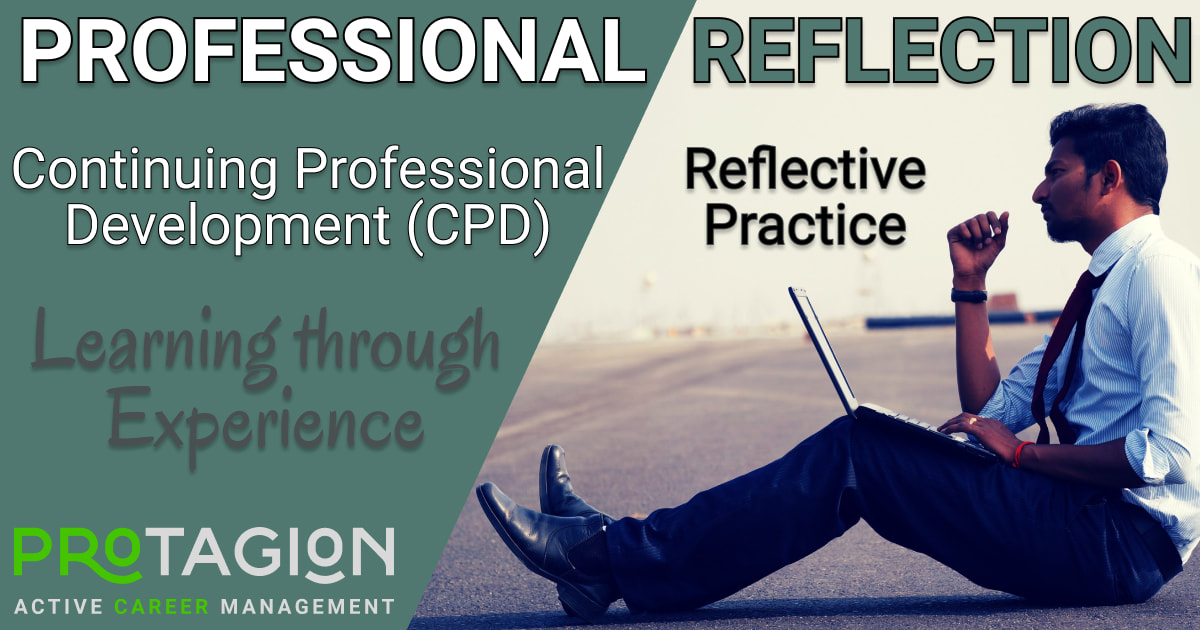
Professional Reflection: Learning through Experience

29/11/2020

0 Comments

 
As professionals, it’s important that we don’t see obtaining our professional qualifications as the end of our development journey, especially as we are still likely to have many decades of work ahead of us after obtaining the letters after our names. Because of this, our professions strongly emphasise that we continue developing beyond qualification, with increasing encouragement for learning over our lifetimes (‘lifelong learning’). A critical component of effective learning is identifying the goals of your desired development, which offer a reference point to compare your introspection, action and progress against.
Picture
Capturing your thoughts while still fresh in your mind, even while on the road!
As we race towards the end of the year, the time for performance appraisals is rapidly approaching again. They offer us the opportunity to reflect on our performance and development, as well as consider what we’d like to do differently in future. In this vein, this article explores the value of professional reflection, drawing from approaches followed across a number of professions. It considers Continuing Professional Development (CPD) and possible activities, and the shift from rules to principles and the increased flexibility for and responsibility on professionals to manage their professional development. Read more to explore different models of ‘reflective practice’, possible drawbacks, and practical frameworks to use for reflecting in a CPD context.

Our follow-on article on the topic of professional reflection ("Getting Value from Reflective Practice Discussions") then delves into feedback and discussion with others about our development, including examples of possible questions in a reflective practice discussion (or diffraction discussion, as at least one professional body calls it).

Read More
0 Comments

Professional & Personal Development Cycles

21/5/2020

4 Comments

 
Life is full of cycles. Round and round. Over and over again… Or perhaps I just notice them more often because of my professional training?
Picture
Two elements which immediately come to mind as fundamental to actuarial training are (i) models, such as financial models, and (ii) the control cycle. A key lesson drummed into us from very early on is that models are simply representations of reality, although they can be very helpful i.e. “All models are wrong. Some are useful.” They depend heavily on the chosen structure for the model and the assumptions inputted and should be stress tested to judge where the model may help and where it may fall down. 

The second element (the control cycle) permeates much of actuarial thinking as it forms the basis for how actuaries add value. The basic cycle (which in itself is a model!) consists of a series of steps:
1) Identify & Specify the Problem, taking the environment and context into account
2) Develop & Implement the Solution
3) Monitor and Respond to Experience i.e. see how things evolve, improve your understanding of the problem, and update the solution
The fundamental strength of a cyclical approach is that it repeats (rather than being linear and coming to an end once the steps have been ticked off). And, while the control cycle can seem quite analytical/quantitative/technical, it can be abstracted more broadly – more on this later.
Career Development
Given my professional background and personal interests, I was naturally keen to apply the ‘cycle’ approach to the world of career development. At Protagion, our approach/philosophy is to start with Knowing Yourself, then make Improvements, and Track Your Progress, getting to know yourself better in the process and making further Improvements i.e. repeating the cycle. This mirrors the control cycle above well. Knowing yourself includes understanding your aspirations, motivators and strengths, and reflecting on your career path and goals. Improving yourself involves gathering feedback and suggestions (both self-directed and external), challenging yourself and getting guidance from mentors and coaches. Tracking your progress is to ensure that the steps you are taking move you forward towards your career goals.

While it shares similar elements, a broader approach than ours is the Personal Development Cycle. Under that cyclical model, we each have a “self concept” i.e. how we see ourselves: who we are, what we do, what we’re good at. Next, something happens (positive or negative, and it may be an uncontrolled event) – some direct examples are: illness, loss of a family member, divorce, losing a job, natural disasters, financial crises, feedback from a boss, a significant raise, moving country, starting a new business… These life experiences cause us to reflect i.e. “self examination”, which leads us to new insights e.g. a commitment to spend more time with our families, or an idea to start a new business or side hustle. We then form new “personal expectations” i.e. how we want to behave, and ideally put in place supporting motivation to help us make the changes we aim for. Where our “self development” succeeds, it leads to an updated “self concept” i.e. personal growth changes us. In effect, maturing/growing is about going through cycles of learning & updating our self concept. It is important to note too that the prompt events causing us to examine ourselves can be indirect e.g. learning from others’ experiences (such as those of mentors), or exploring our inner drives and imagining possible situations (perhaps with the support of a coach). Although not as intense, learning from others can be significantly faster than direct experience, partly because there are more opportunities to learn from and we can dive into the lessons rather than living through the pain or joy of the event itself.
Control cycles: inner and outer
Back to the actuarial control cycle: the original control cycle is analytical in nature, and has been expanded into two separate, but related, cycles by Jules Gribble and Lesley Traverso. Jules is an actuary by profession (a Fellow of the Society of Actuaries (FSA) in the US and Fellow of the Institute of Actuaries of Australia (FIAA)) and Lesley has a recruitment background and is director of Talent Insights Group in Sydney. They posit that using two separate cycles “makes it clear that it is a process... to be applied in multiple and diverse areas”. The original control cycle is used as the inner cycle, focusing on technical skills: “The steps [1-3 earlier] can be rephrased as ‘What do you want to do’, ‘Attempt to do it’ and ‘See if it worked (and if not redress the issues)’.”

The second, outer cycle looks at broader issues around the inner model, and focuses more on ‘softer’ skills which pick up on behavioural, cultural and ethical matters i.e. it covers aspects like governance, interpretation and communication, and is more strategic and qualitative in nature. It requires synthesis of models used in the inner cycle and interpretation of results in a broader context to inform decision makers. The two-cycle approach implies a blend of specialist/analytical skill and generalist/interpretative skill is important –  a topic explored in our past article on Specialising vs Generalising as a Career Strategy.
Application to career management
This approach of dual levels of detail in the overall process can be applied to career management and personal development too. The inner cycle concentrates on the individual actions on a regular basis, concrete steps to take (and track) towards your career goals like a promotion or new skills to master. However, the Know, Improve, Track (in Protagion terminology) framework can be applied at an abstracted, outer level too i.e. a strategic perspective on your career, including broad concepts like purpose and meaning. Do you fully appreciate your long-term resonating goals and are your compounded short-term actions leading you to achieve them?

Afterword
This post has concentrated on elements from my actuarial professional background and corollaries in career development. Do similar cycles exist in other professions? Please share your thoughts in the comments. For example, I don’t recall such cycles being part of my Chartered Financial Analyst studies (barring economic cycles) – but that may be my memory… For example, reflective practice in the medical profession is one application of steps 1-3 in a continuing professional development context. Which others have you come across in your professional experiences?
4 Comments

Qualifying as a Professional: Challenges of Studying & Working

31/3/2020

1 Comment

 
Given our focus on professionals and their career goals, Protagion’s members tend to share a common experience during their lives: the challenge of studying and working simultaneously. Many professionals attest to the personal effort, dedication and diligence required in tackling their professional exams, particularly at board or fellowship level. While this pressure often arises during the earlier years of their careers, it can arise later too, if for example, they study further or write additional exams to change specialism or profession. And, once complete, the sense of accomplishment (and relief) is well-earned – every qualification is a substantial achievement to be celebrated! I know of an actuary who vowed to celebrate every week for a full year once she was done...

Two specific difficult areas which professionals reference are:
  • Making the change from studying full-time at university to balancing working and studying in your first job – it can take some time to find a rhythm which works personally, and support from your employer (such as study leave and/or payment of exam fees) can be very helpful in lessening the pressure
  • Picking yourself up again after failure, especially if you’ve written the exam multiple times already (not again!) – repeated failure can be psychologically devastating, especially considering the superhuman effort required to study for and write each paper
Picture
The global contagion and national lockdown responses this year are adding significantly to the stress involved in writing professional exams, including:
  • Uncertainty about whether the scheduled exams (which students will have dedicated months of study time to already) are going ahead; some professional bodies are making online alternatives available, but changes to the “exam conditions” that you prepared under can be incredibly disturbing to your state of mind
  • The impact of working from home on your study routine, compounded by family responsibilities you may have too such as homeschooling children or looking after relatives who live with you

Even under normal circumstances the nature of your role affects your possible study schedule. For example:
  • if you have client commitments, like a consultant might
  • if you have times of the year that are particularly pressurised at work, such as in a financial reporting area
  • if there is a pressing project (say a product launch or reprice or system upgrade) with a deadline near your exam dates

​Vacancies or unplanned absence
of your teammates can also contribute to additional work pressures. And, especially now given the possibilities of people falling ill, study leave may be cancelled at short notice in order to deliver on corporate priorities. Some roles will also be facing additional work at present, like those in risk management or business continuity areas. 

All of this work pressure is compounded with the team working from different home locations, possibly with less reliable access to the software and systems needed to operate optimally. Communication within the team and with seniors can also be more challenging.
Some suggestions for how to manage work and studying while working from home:
  1. Ask those in your home for their continued support in getting through your exams – this may involve showing them the hours required of you to prepare for each paper, as well as your planned study schedule
  2. Set aside specific days and/or times (such as evenings) for studying, including setting yourself targets for the number of chapters and/or exam questions to get through in each study session – it is important to get into a regular routine, even in the midst of the current turmoil
  3. If you find work colleagues are interrupting you during your dedicated study times, speak to them respectfully during your allocated work time; consider including on your email signature which are your study days and adding an out-of-office message on those days, confirming when you'll be back online and able to address work queries
  4. If possible, designate specific zones at home for different purposes i.e. a study space and a work space as this will help separate the two activities for you; ideally leave your phone, laptop and other work equipment in the work zone so that they are not accessible when you’re in your study zone
  5. Make commitments to others as to your weekly study progress, such as someone studying the same exam as you, your boss and/or your family – these public pledges can demonstrate to others how serious you are, as well as motivate you to honour them
Do you agree? Any other suggestions to achieve both passes and promotions? Which techniques have helped you study for professional qualifications while simultaneously delivering above expectations at work? Please also share further ideas to manage the particular challenges of doing this while working from home.

A final thought: given the significant personal and professional stresses we’re all facing at the moment, one of Protagion’s coaches in South Africa has very kindly offered to support our professionals with their current worries by offering a free confidential coaching session per person. Her intention is to be of service and support others through this difficult time, including sharing what she personally practises to remain calm in stressful situations. Please contact us if you’d like to take up Gretha’s offer of a space for those in need to unpack, offload and lessen some of the emotional stress.
1 Comment
<<Previous
Forward>>

    Follow @Protagion

    Author

    Bradley Shearer
    ​Founder of Protagion
    My Personal Journey
    I'd love to hear your stories

    SHARE YOUR
    STORY WITH ME

    Categories

    All
    Active Career Management
    Branching Out
    Connection
    Consulting
    Contracting
    Future Of Work
    Inspiration
    Leadership
    Learning
    Mentoring
    Non Executive Directors (NEDs)
    Personal Journeys
    Professions
    Psychology
    Real Life Examples
    Role Options
    Routes To The Top

    RSS Feed

"NOW WHAT?" - a common question our visitors ask...
​WE CAN HELP!
Examples of common career goals, with resources for each: promotion, new skills, further study/qualifications, moving countries, switching into consulting / contracting / startup, transition to new specialism or profession, managing a business, portfolio career, purpose & meaning, CPD, and more... 


Follow @Protagion
Home / Proteges
> ​Services
> Subscribe
> CPD
​​

​Mentors

Our Stories / Blog

Sign Up to use our System
​
​
Privacy Policy​
Career Development and Talent Management for professionals: accountants, actuaries, analysts, asset managers, bankers, CFAs, data scientists, engineers, investment managers, risk managers, and more...
Protagion currently offers services in English, although some of our mentors & coaches speak other languages too. ​Please email us if you have any questions.
Picture

​© 2017-2026 PROTAGION LIMITED (10721032) is a company registered in England and Wales.
Registered Address: 128 City Road, London, United Kingdom, EC1V 2NX

Photos from Pjposullivan1, paul.horsefield, flazingo_photos, wuestenigel (CC BY 2.0), SURF&ROCK (Miguel Navaza), symphony of love, timo_w2s, ksunderman, Pjposullivan1, www.ilkkajukarainen.fi, Official U.S. Navy Imagery, Pjposullivan1, Kuruman, Pricenfees, Tennis-Bargains.com, wuestenigel
  • Proteges
    • Now What?
    • Career Support Guide
    • Career Goals >
      • Promotion / Raise
      • New Skills
      • Further Qualifications
      • Moving Countries
      • Switching: Consult/Contract/Startup
      • Transition: Specialism/Profession
      • Managing a Business
      • Portfolio Career
      • Purpose & Meaning
      • CPD
      • (Conference 1-5 Mar '21)
    • Example Professions >
      • Accounting
      • Actuarial
      • Asset & Investment Management
      • Risk Management
      • And more... >
        • Talent Management for Professionals
    • Our Services
    • Courses
  • Mentors
    • Encore Mentor
    • Featured Subset >
      • Anne - Australia
      • Boniswa - S Africa
      • Bradley - UK
      • Cherise - Nigeria
      • Hafsa - S Africa
      • Lee - Hong Kong
      • Lusani - S Africa
      • Margaret - S Africa
      • Michael - S Africa
      • Natasha - UK
      • Nikki - UK
      • Sumit - India
      • Trevor - UK
      • And More on our Protege Platform...
  • Subscribe
  • Platform Login
    • Login
    • Sign Up: Free
  • Stories
    • Our Stories & Articles
    • Our Principles
    • Books